
Applied Biostatistics and Data Analytics for Pharmaceutical Sciences
About Course
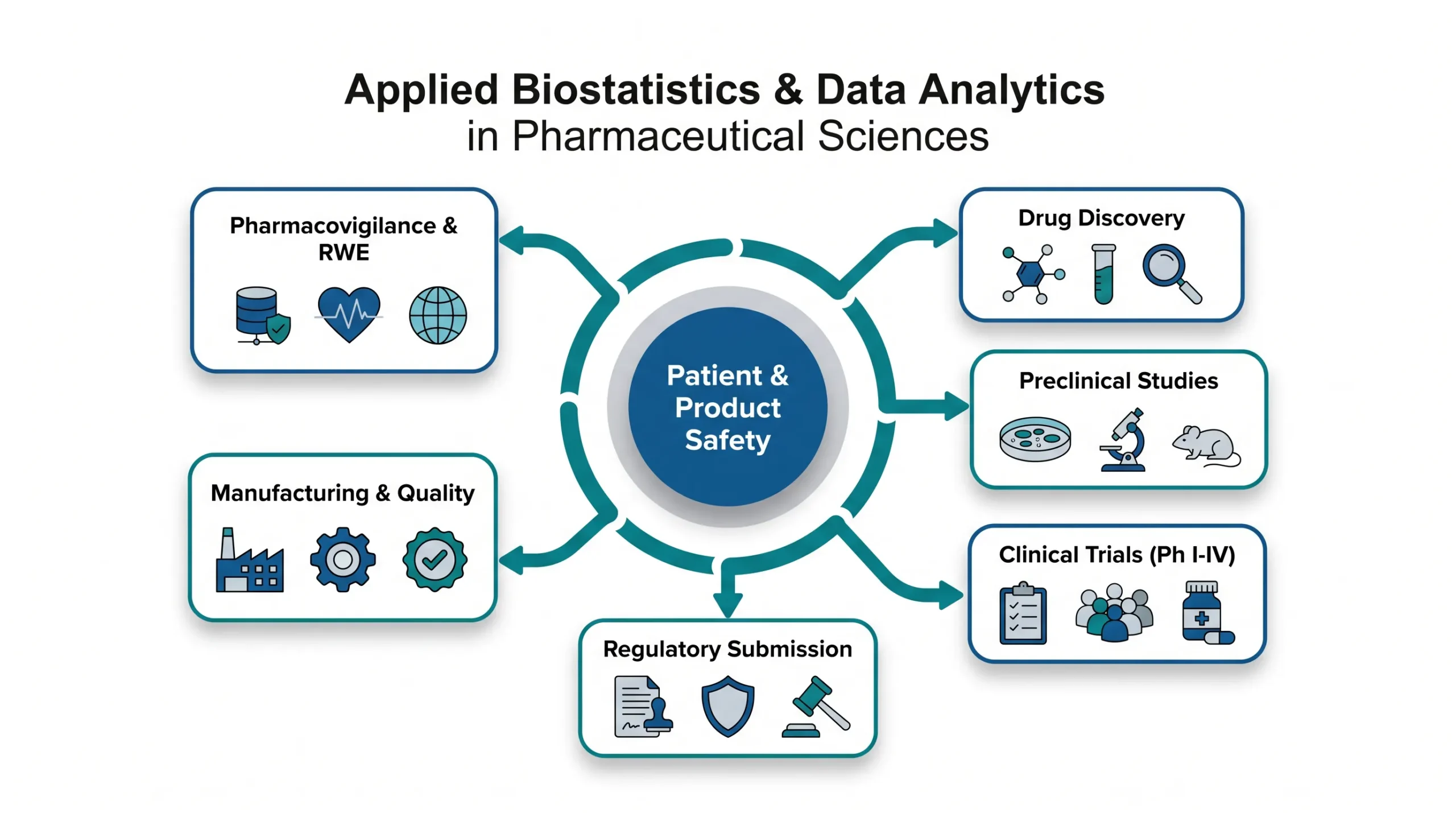
Master the statistical and data analytics skills that today’s pharmaceutical, clinical research, and healthcare industries demand. This industry-aligned course delivers hands-on training in applied biostatistics, equipping pharmacy graduates, M.Pharm students, and life sciences professionals with a practical, Python-powered toolkit for real-world pharmaceutical data analysis.
Across five structured units, learners progress from core descriptive statistics and probability distributions to hypothesis testing, confidence intervals, correlation, and linear regression — all contextualized within high-stakes pharmaceutical environments including clinical trials, pharmacovigilance, quality control, and pharmacokinetic studies.
What sets this course apart is its Python-based learning framework. Using industry-standard libraries — NumPy, Pandas, SciPy, Statsmodels, and Scikit-learn — you will perform statistical analysis on real pharmaceutical datasets, interpret p-values, build regression models, and generate publication-ready statistical reports — skills directly applicable to roles in clinical data management, biostatistics, CRO/pharma analytics, and regulatory submissions (FDA, EMA, CDSCO).
By course completion, you will be able to:
-
Perform complete biostatistical analysis using Python
-
Apply Bayes’ theorem to clinical decision-making
-
Calculate sample parameters and confidence intervals
-
Interpret dose-response relationships and odds ratios in clinical risk analysis
-
Support evidence-based decision-making and entry-level machine learning in healthcare
Whether you are a pharmacy student targeting biostatistician roles, a researcher seeking data analytics proficiency, or a professional preparing for clinical research careers — this course delivers measurable, job-ready outcomes.
Enroll now and lead with data.
Course Content
Descriptive Statistics
-
Introduction to Data & Data Types